There is a reason anglers call the northern pike the freshwater wolf. Few fish in North America or Europe hit a lure with the same violence, and fewer still combine that aggression with the cold-blooded patience of a true ambush predator. A big pike will sit motionless in the weeds for an hour, then cover ten feet in a heartbeat to crush a bait. Hook one and you get head shakes, surging runs, and that nerve-rattling moment when a green torpedo rolls boatside.
Pike are also one of the most accessible trophy fish out there. They live in lakes, rivers, and reservoirs across the northern hemisphere, they eat almost anything, and they grow large. If you want to graduate from panfish and bass into something that genuinely pulls back, the pike is your fish. This profile covers how to identify them, where they live, what they eat, and how to put more of them in the net.
Identification
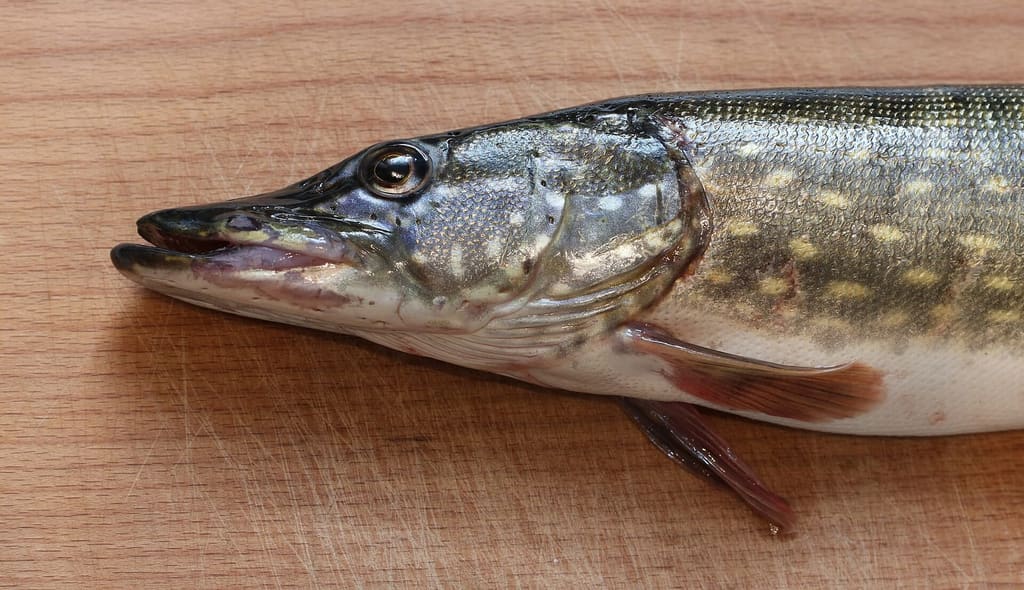
The northern pike (Esox lucius) has an unmistakable build: long, cylindrical, and torpedo-shaped, with the dorsal and anal fins set far back near the tail. That rearward fin placement is the giveaway of an ambush predator built for short, explosive bursts rather than long-distance cruising.
Key identifying features:
- Olive-green to dark green body fading to a cream or yellowish belly.
- Light, bean-shaped or oval spots arranged in rows along the flanks. This is the opposite of the muskellunge, which has dark markings on a lighter background.
- A broad, duck-bill-shaped snout packed with sharp teeth.
- Fully scaled cheeks but only the upper half of the gill cover scaled, another way to separate them from muskies.
The pike most often gets confused with the muskellunge and, where ranges overlap, the chain pickerel. Remember the rule: light marks on dark equals pike, dark marks on light equals muskie. Pickerel are smaller and show a chain-link pattern.
Range and Habitat
Pike have one of the widest natural distributions of any freshwater fish. They are found across Canada, the northern United States, and throughout northern Europe and Asia. In the U.S. they are common through the upper Midwest, the Great Lakes region, New England, and parts of the Rocky Mountain states, with stocked or introduced populations well beyond their native range.
Within a body of water, pike relate to two things above all: cover and cooler water. Look for them around:
- Weed edges and submerged vegetation, especially cabbage and coontail beds.
- Drop-offs where shallow flats fall into deeper basins.
- Points, inside turns, and the mouths of bays.
- Wood, rock piles, and any structure that breaks current in rivers.
As a cool-water species, pike are most comfortable in water roughly in the 55 to 70 degree Fahrenheit range. In summer, larger fish often slide deeper or hold near cooler inflows and spring-fed areas, while smaller pike stay shallow.
Diet and Forage
Pike are opportunistic, and they are not picky. Their diet is built around whatever baitfish is most abundant: yellow perch, ciscoes, suckers, shiners, and smaller panfish are all standard fare. They will also take frogs, crayfish, ducklings, small mammals, and other pike. Cannibalism is common, which is one reason pike spread out rather than school tightly.
That broad appetite is good news for anglers. It means a pike will commit to a large profile bait, and it means flash, vibration, and erratic movement all trigger strikes. A pike eats with its eyes and its lateral line, so anything that looks injured or vulnerable gets attention.
Seasonal Behavior
Pike behavior shifts dramatically through the year, and matching your approach to the season is the single biggest factor in consistent success.
Spring
Pike are among the earliest spawners, moving into shallow, weedy backwaters and marshes shortly after ice-out when water is still in the 40s. Post-spawn, they remain in or near those shallow areas to feed and recover. This is one of the best windows of the year to catch numbers of fish, and often the biggest females.
Summer
As water warms, smaller pike stay shallow in the weeds while larger fish frequently move to cooler, deeper structure near the thermocline or main-lake points. Early morning and late evening fish best. Midday in midsummer, target deeper weed edges and breaklines.
Fall
This is prime trophy time. As water cools, big pike feed heavily to prepare for winter and push back toward shallower structure. Large baitfish-imitating lures shine now, and the average size of fish caught climbs.
Winter
Pike feed actively under the ice and are a top target for ice anglers, typically caught on tip-ups baited with large dead or live shiners and suckers set near weed edges and drop-offs.
Best Baits and Lures
Pike respond to a wide range of presentations. A few categories consistently produce:
- Spoons. The classic pike lure. A red-and-white or five-of-diamonds spoon cast and retrieved with an occasional pause is hard to beat. The wobble and flash imitate a wounded baitfish perfectly.
- Inline spinners and large spinnerbaits. Heavy thump and flash that pike track easily, even in stained water. Great for covering weedy water.
- Soft plastic swimbaits and large jerkbaits. Big paddle-tail swimbaits and minnow-shaped jerkbaits in perch, shiner, or firetiger patterns trigger reaction strikes.
- Bucktails. Steady, hypnotic retrieves through and over weeds draw committed strikes, especially in warmer water.
- Live and dead bait. Large shiners, suckers, and dead smelt under a float or on a quick-strike rig are deadly, particularly in cold water and through the ice.
Techniques and Tackle
You do not need exotic gear for pike, but you do need to respect their teeth. The non-negotiable item is a leader.
- Leader. Always run a wire leader or a heavy fluorocarbon leader of at least 40 to 60 pound test. Pike teeth slice through straight braid or mono in an instant, and a leader is the difference between landing a trophy and losing it.
- Rod and reel. A medium-heavy to heavy rod around 7 feet, paired with a reel spooled with 30 to 50 pound braid, handles both casting big lures and muscling fish out of weeds.
- Retrieve. Vary your speed and add pauses. The pause after a burst is when most strikes happen. In cold water, slow everything down; in warm water, speed up and trigger reaction bites.
- Cover water. Pike are spread out and territorial. Cast to obvious cover, fan out from points and weed edges, and keep moving until you find active fish.
Handle pike carefully for release. Use a large rubber-mesh net, keep the fish horizontal and supported, use a jaw spreader and long pliers to free hooks, and minimize air time. These predators are valuable to the fishery, and big females especially deserve a quick, clean release.
Realistic Size and Records
A typical pike in most fisheries runs in the 20 to 30 inch range, weighing a few pounds. A fish over 30 inches is a solid catch worth a photo, and anything over 40 inches is a genuine trophy that many dedicated pike anglers chase for years. The largest fish are almost always females.
The species reaches its greatest sizes in cold, food-rich waters of northern Europe and Canada, where fish well into the 40-inch class and over 20 pounds are landed each year. Set your personal goals against your home water rather than the all-time records: in many lakes, a clean 38 to 40 inch fish is the realistic ceiling and a worthy lifetime target.
Final Thoughts
The northern pike rewards anglers who learn to read cover and adjust to the seasons. Find the weeds and edges, throw something with flash and profile, protect your line with a leader, and be ready for an explosive strike. Whether you are casting spoons on a spring flat or watching a tip-up flag pop on a frozen lake, the freshwater wolf delivers some of the most thrilling action in fresh water. Tie on a leader, find the green water, and go hunt one down.